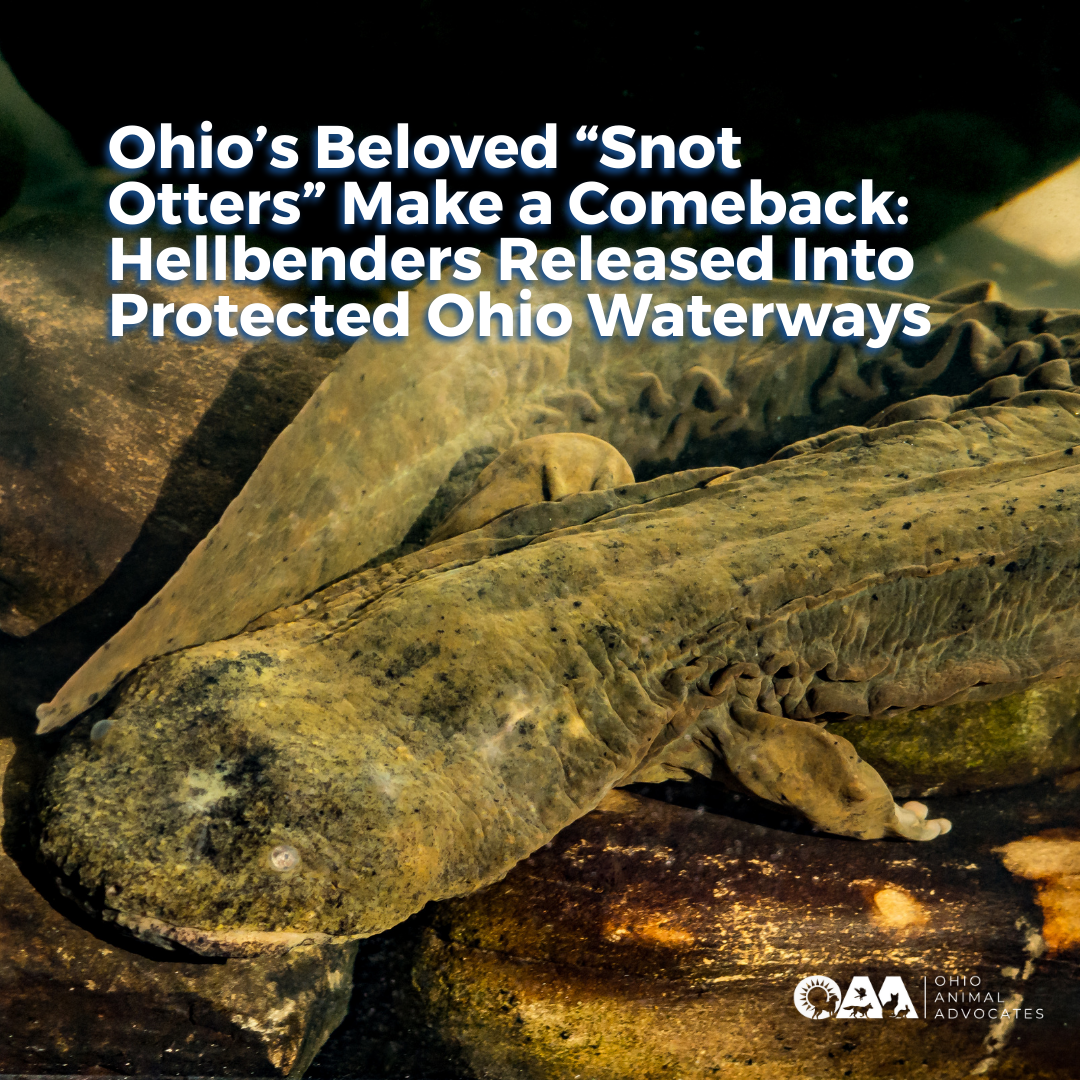

Ohio’s waterways just welcomed back some very unusual—and very important—residents. This summer, scientists and conservation partners released 116 juvenile eastern hellbenders into protected streams in eastern Ohio, marking another exciting step forward in the fight to save this threatened species.
Eastern hellbenders (Cryptobranchus alleganiensis) are North America’s largest salamanders, growing up to two feet long. Their wrinkly skin and slimy coating have earned them the unforgettable nickname “snot otters.” While quirky and lovable, these amphibians play a critical role in keeping Ohio’s waterways clean and healthy.
Unfortunately, hellbender populations have been declining across much of their range—and in some regions, they have disappeared altogether. Loss of habitat, pollution, increased sedimentation, and declining water quality all threaten their survival.
But here in Ohio, conservationists are giving hellbenders a fighting chance.
A Collaborative Effort to Save an Ohio Native
The recent release is part of the Ohio Hellbender Partnership, a statewide conservation effort led by:
Columbus Zoo and Aquarium
The Wilds conservation center
Ohio Department of Natural Resources
Ohio State University
Additional research and conservation partners
Since 2012, the partnership has reintroduced more than 2,000 captive-raised hellbenders into Ohio streams. Their hard work is paying off: In 2023, researchers confirmed that reintroduced hellbenders are successfully reproducing in the wild—a huge milestone for the species’ long-term recovery.
“This is quiet work that adds up,” says Greg Lipps, conservation biologist at the Columbus Zoo and Aquarium. “One stream, one release, one more sign that clean water and wildlife can thrive together in our community.”
Building Homes for Hellbenders: “Hellbender Huts”
To support the growing population, researchers recently installed 30 new “hellbender huts,” bringing Ohio’s total to over 130 artificial shelters. These concrete structures mimic the natural crevices hellbenders rely on for protection and nesting.
The huts are already working: Researchers found 19 shelters occupied, with eggs laid in at least two of them this season.
The team also collected more than 2,000 eggs from three nests—some of which will help support hellbender recovery efforts in neighboring Indiana.
Head-Starting: A Conservation Strategy That Works
The backbone of Ohio’s recovery effort is a technique called head-starting. Here’s how it works:
Biologists collect eggs from healthy wild nests.
The eggs are raised in controlled, safe environments.
Once the juveniles grow large enough to avoid predators and disease, they’re released into carefully selected streams.
Each young hellbender is tagged so scientists can track survival and reproduction.
This method dramatically improves the odds that a hellbender will reach adulthood—a major win for a species that faces many threats early in life.
Why Hellbenders Matter: A Window Into Water Quality
Eastern hellbenders only survive in fresh, clean, well-oxygenated water, making them a powerful indicator species. When hellbenders disappear from a stream, it’s a sign that something is wrong with the ecosystem.
A recent study published in Freshwater Biology highlighted one of the most significant threats they face: sedimentation. Fine silt fills the spaces beneath rocks where hellbenders lay eggs and where larvae take cover, destroying critical habitat.
The research team’s message is clear:
Protect streams from sedimentation
Restore rocky riverbeds
Preserve and replant forested streambanks
Healthy habitat is key to giving hellbenders—and countless other species—a chance to thrive.
A Win for Ohio Wildlife and Local Ecosystems
The successful reproduction of lab-reared hellbenders and the continued expansion of habitat support structures offer great hope for the future of this species in Ohio. Every juvenile released, every egg collected, and every restored streambank is a powerful reminder that conservation works.
Protecting hellbenders protects entire ecosystems—and ultimately benefits all of us who rely on clean, healthy waterways.
Ohio’s wrinkled, wondrous “snot otters” are making a comeback, and that’s something worth celebrating.
To learn more about other wildlife challenges in Ohio, visit our webpage on wildlife protection at https://www.ohioanimaladvocates.org/wildlife-protection.