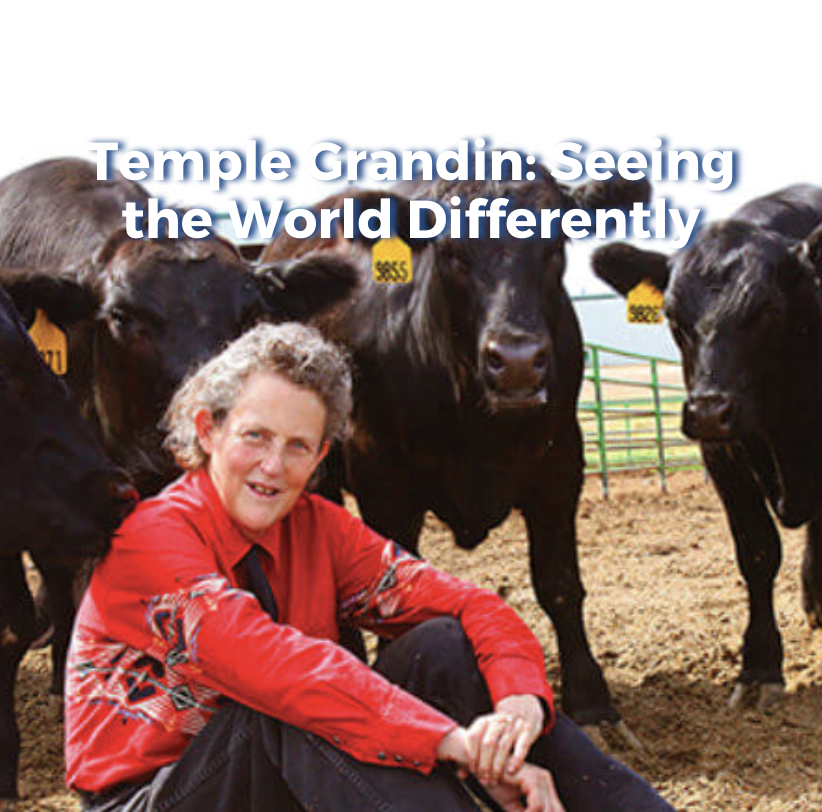
When four new portraits were unveiled at the Smithsonian National Portrait Gallery, they honored individuals whose work reshaped American history and culture. Among them was Temple Grandin—a woman whose influence spans animal welfare, science, and how society understands autism.
Grandin’s portrait shows her in a setting that defines her life’s work: standing among cattle, dressed in her familiar embroidered shirt and bolo tie. It’s a visual reminder that her legacy is grounded not in abstraction, but in observation—careful, compassionate, and deeply practical.
Transforming Animal Welfare by Paying Attention
Long before humane livestock handling became an industry standard, Temple Grandin was asking a simple but radical question: What does the animal experience?
Early in her career, she began stepping into cattle chutes herself—literally lowering herself to the animal’s eye level. What she noticed changed everything. Shadows, reflections, dangling chains, parked vehicles—small visual details invisible to humans were overwhelming to animals.
By redesigning facilities to reduce fear and stress, Grandin demonstrated that humane treatment and operational efficiency are not in conflict. Today, her principles influence how nearly half of cattle in North America are handled—proof that empathy, when paired with science, can create lasting systemic change.
Autism as a Strength, Not a Limitation
Grandin was diagnosed with autism as a child and did not speak until nearly age four. At the time, experts advised institutionalization. Her mother refused—and instead focused on education, structure, and high expectations paired with thoughtful accommodations.
Grandin now credits her autism as a central reason for her success. She describes herself as an “object visualizer”—someone who thinks entirely in pictures. This way of thinking allowed her to see patterns, mechanics, and spatial relationships others missed.
What she didn’t realize until adulthood was that not everyone thinks this way.
Why Different Thinkers Matter
Through decades of teaching, research, and collaboration, Grandin has become a powerful advocate for recognizing different cognitive strengths. She warns that education systems often filter out hands-on, visual thinkers by overemphasizing abstract math—excluding people who may excel at mechanics, engineering, animal handling, and skilled trades.
She often asks a pointed question: Who do you want fixing the hydraulics on an airplane?
For Grandin, the answer is clear—someone who can see how systems work, even if they struggle with algebra.
In a world increasingly focused on automation and artificial intelligence, she argues that visual and mechanical thinkers are more essential than ever. Machines may calculate, but humans still build, repair, and understand physical systems in ways AI cannot replace.
A Broader Definition of Success
Beyond her contributions to animal welfare and science, Temple Grandin’s story offers a broader lesson: progress depends on embracing difference. Whether in classrooms, workplaces, or policy decisions, societies thrive when they recognize and develop individual strengths instead of forcing everyone into the same mold.
Her portrait now hanging in the National Portrait Gallery is more than an honor—it’s a statement. It says that compassion, observation, and unconventional thinking belong at the center of our cultural story.
And perhaps most importantly, it reminds us that seeing the world differently isn’t a deficit—it can be a powerful force for change. pasted