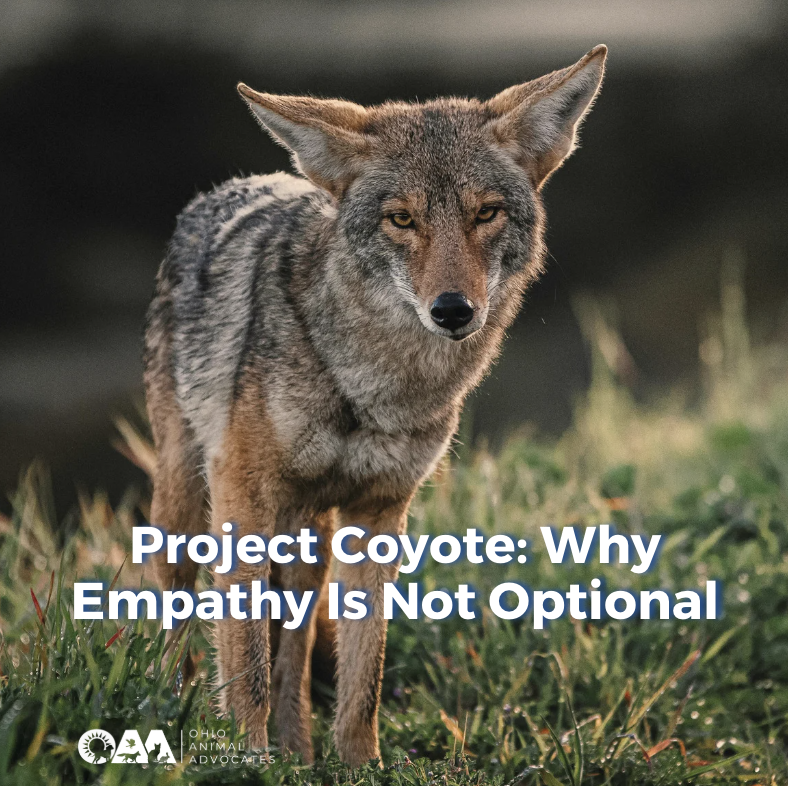
Project Coyote recently welcomed Ann Piquette as their new Development Operations Coordinator, and her story is a powerful reminder of why empathy remains at the heart of effective animal advocacy.
Long before Ann stepped into professional advocacy work, compassion shaped the way she understood the world. She grew up in a home where animals in need were never turned away. Injured strays, neglected pets, and displaced wildlife all found care—not because her family had formal training, but because responding to suffering felt nonnegotiable. Dogs and cats often became permanent family members, while wild animals were stabilized and returned to their natural environments, sometimes with support from wildlife rehabilitation professionals.
Those early experiences formed more than habits of care; they cultivated a deep sense of responsibility and awareness. Daily routines—feeding schedules, long walks, quiet moments spent together—taught Ann patience and presence. Animals offered steadiness during difficult times, providing connection without expectation. They also introduced her, at a young age, to one of life’s most enduring truths: that loving deeply means learning how to grieve.
As Ann grew older, she gravitated toward the work of animal advocates and conservation leaders whose lives were guided by empathy and justice. Learning about figures such as Dr. Jane Goodall helped crystallize an important realization—that empathy is not universally practiced, and that how people treat animals often reveals their values more clearly than words ever could. Compassion, Ann learned, carries responsibility: to notice harm, to resist complacency, and to speak up when injustice is present. That understanding became a lens through which she continues to view both advocacy and the world at large.
Today, empathy can feel increasingly undervalued. In a culture shaped by outrage cycles, misinformation, and emotional distance, compassion is often dismissed as naïve or impractical. Detachment can appear easier than sustained engagement—but disengagement comes at a real cost.
Ann’s work stands firmly in opposition to that impulse. She views empathy not as weakness, but as a discipline—one that requires consistency, courage, and care. It is grounded in the understanding that animals, people, and ecosystems are deeply interconnected, and that individual choices ripple far beyond ourselves.
Shortly before Ann joined Project Coyote, the passing of Dr. Jane Goodall brought renewed attention to her legacy. One sentiment, often echoed in her words, continues to resonate: that each of us is given a choice—to use our lives to make the world better, or not to bother. For Ann, choosing not to act has never been an option.
Caring for animals—whether companion animals, community cats, or wildlife—is not only about conservation or policy. It is also emotional stewardship. It is the ongoing practice of recognizing that lives matter even when they are inconvenient, misunderstood, or unseen. Compassion is built through daily actions and long-term commitment.
As Project Coyote welcomes Ann to their team, her story serves as a reminder that empathy is not naïve. It is necessary. And it remains one of the most powerful tools available to those working to build a more just and humane world for animals and for the communities they inhabit.
Take Action: Defend Wildlife, Defend Empathy
Right now, wildlife across Ohio and beyond face growing threats disguised as tradition or recreation. We invite you to take a stand by engaging with Ohio Animal Advocates’ current action alerts:
Oppose the “Right to Hunt” Amendment — Speak out against proposals that could weaken wildlife protections and undermine responsible, science-based management.
Speak Out Against Wildlife Killing Contests — These contests promote cruelty, disregard ecological balance, and have no place in humane wildlife stewardship.
You can also explore our Wildlife Protection advocacy page to learn more about how Ohio Animal Advocates is working to protect wild animals through policy, education, and accountability.
Finally, sign up for our newsletter to receive action alerts, updates, and advocacy opportunities delivered straight to your inbox. Staying informed is one of the most powerful ways to make a difference—for wildlife, for ecosystems, and for the values we share.